May 1st – Belem

We’re told to take the tram to Belem, where Portugal’s most famous piece of architecture lives.  After boarding the crowded tram, we realize the machine accepts coins only, of which we have none.  We desperately ask people to make change for our paper money, but no one has any.  We notice that they really do make a valiant effort to look – very unlike what we’re used to in America.  After giving up and simply hoping we won’t be kicked off this tram, we notice that one of the men we originally asked for change had made his way to the front of the crowded tram, and is now pushing his way back in our direction.  He gives us coins, and it’s apparent that his trek through the crowd to the front of the tram was solely a mission to get us the change we needed.  We’re astounded by his kindness.

We pass our desired stop at Belem, but when we get off one stop later, we’re standing in front of the Jeronimos Monastery, a centuries’ old, vast building with domes and iron wrought spokes extending across its massive roof.  We admire the architecture for a long time and walk around the gardens surrounding the monastery.  There’s a beautiful fountain directly in front, which adds to this amazing scenery.  We see an interesting looking sculpture in the distance, up by the water, so we head in that direction.  The sculpture hangs over the Tagus River, depicting various 16th century prominent figures boarding a ship.  It was such an interesting structure, and the placement of it hanging over the river made it that much more impactful.
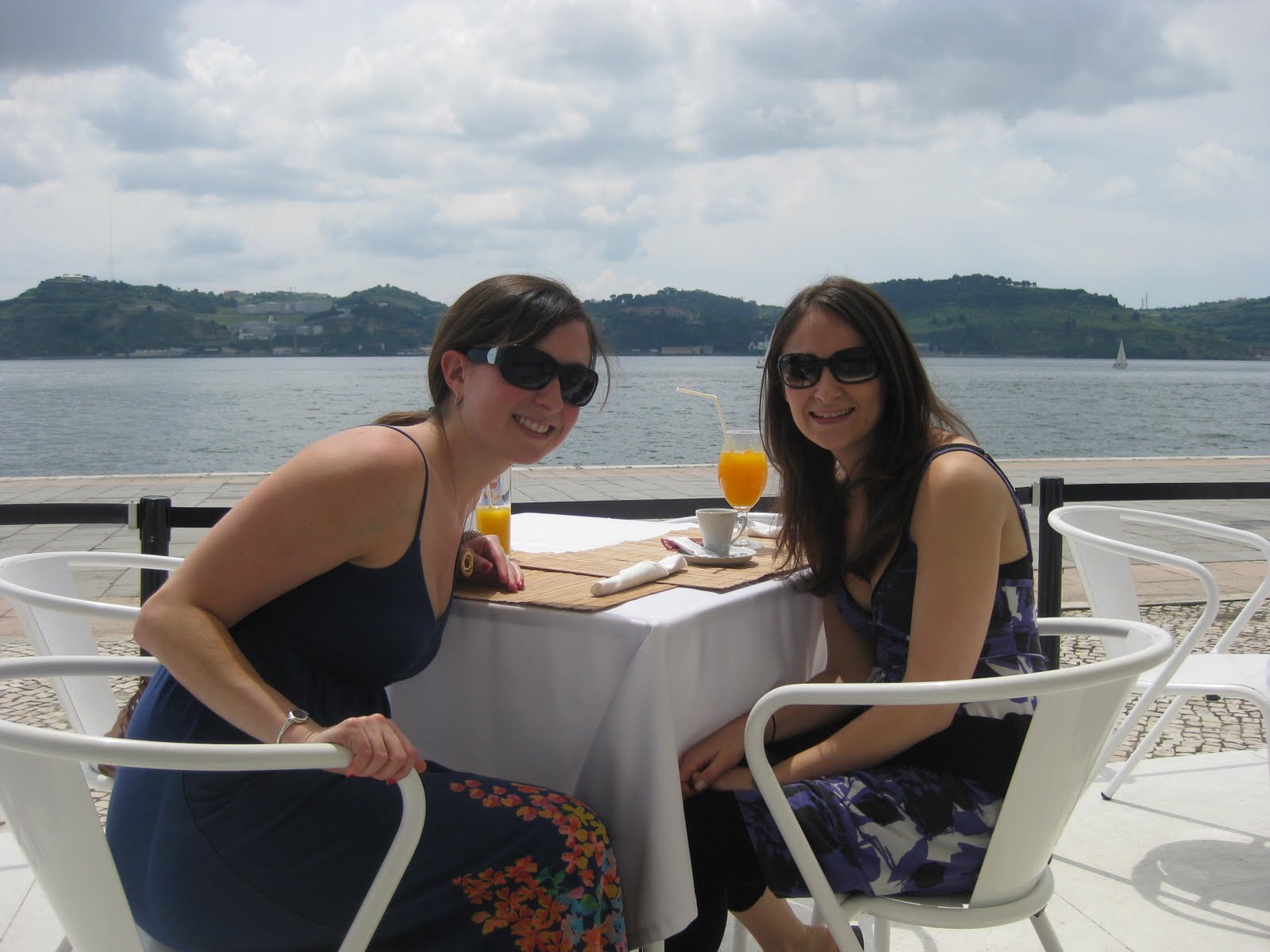
At the base of this sculpture, we find ourselves on a path along the Tagus, looking at the Torre de Belem in the distance.  As we enjoy our lovely stroll across the river, we stop at one of the ultra simplistic cafes that pop up along the path.  By simple, I mean the décor of these restaurants consisted only of white walls with floor to ceiling glass windows, with outdoor and indoor seating.  We had a quick orange juice and sandwich as we stared across the Tagus at the rolling hills and terra cotta covered homes dotting the Portugese landscape.
We continue on and reach the Torre de Belem, the most famous structure in Portugal, a castle/fortress standing since the 1500’s.  We walked around and admired it from all angles.  As we walked away from the fortress, we stumbled upon a military memorial, guarded by two military soldiers.  Fully dressed in uniform, the soldiers were slowly marching towards each other in front of the memorial.  When they reached each other, they promptly turned around, and slowly marched back to their individual posts at either end of the memorial.
 
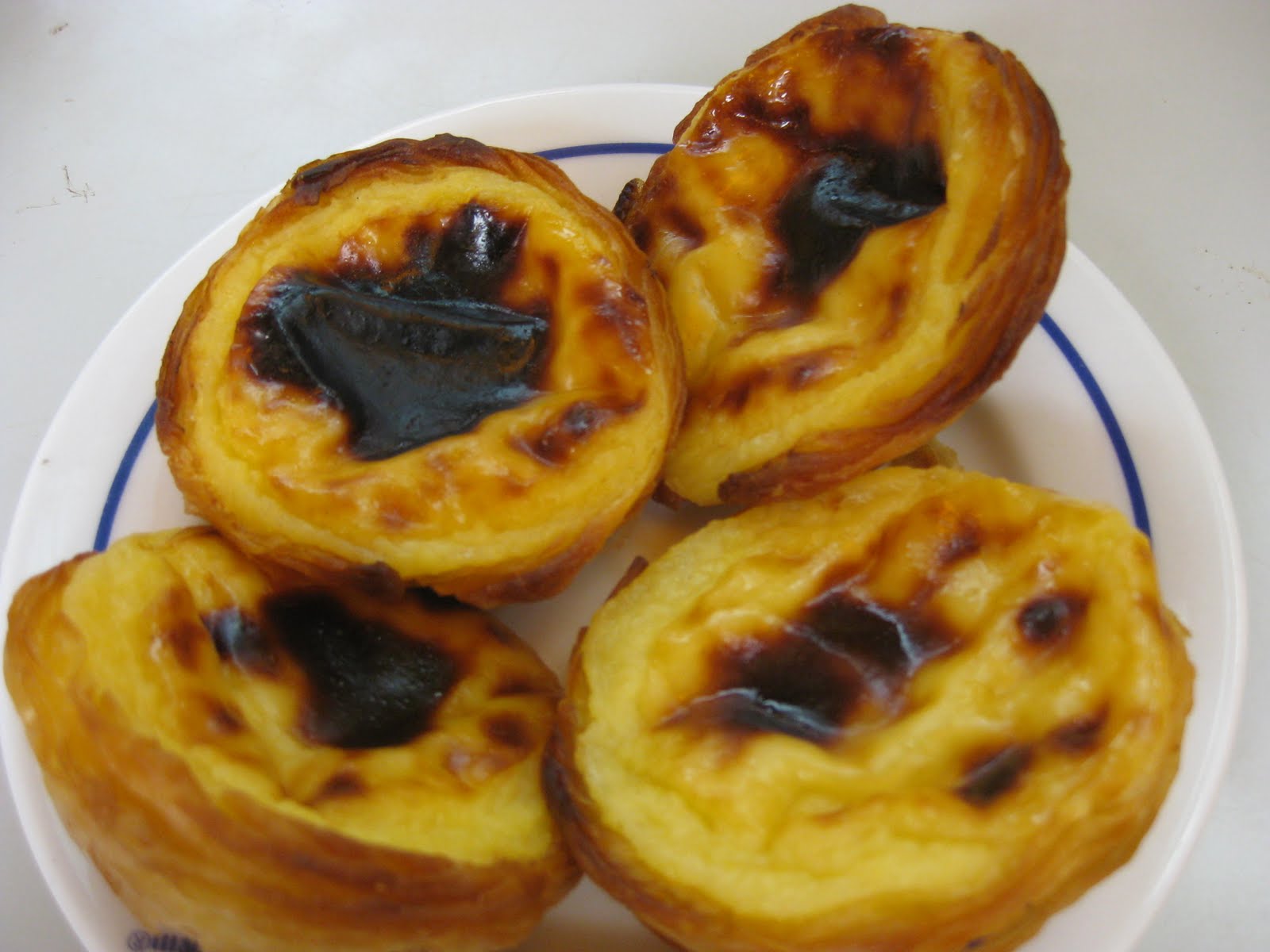
Next, we made our way to the famous Pasteis de Belem, which I can only describe as the Café du Monde of Portugal.  Sitting at a table in a large area crowded by tourists, our disgruntled server brought us our coffee and pastries.  These were no beignets, though.  The following description won’t do the pastries justice, but these were the most amazing creations, crispy, caramelized goodness on the outside with creamy, cheesy deliciousness on the inside.  Randi and I were in a complete daze as we lost ourselves in these delicacies, savoring every single bite.
Dinner that night was at a restaurant called AlCantera, located in the neighborhood of the same name.  The expansive restaurant with high ceilings and nude statues was almost empty, and we’re told this is because it’s Sunday, and May 1st, which is Portugal’s national Labor Day holiday.  The décor reminds me of Morocco with the high ceilings, wood paneling and wooden fans hanging down from the ceiling.  Everywhere we go in this country reminds us of somewhere we’ve been, but really, it’s like nowhere we’ve seen.  There’s a little Israel, Spain, Italy, even New Orleans here.  We’re still encountering confusion followed by delight everywhere we go.

A Night Out in Lisbon: Confusion, followed by Laughter

When we return to the hotel after our first meal debacle and admiring a fusion of Asian, European, Egyptian and Persian art at the Gulbenkian, there is a message for us in our room.  The hotel has to move us out of the room they originally put us in when we arrived at 6 a.m. that morning, because they’re doing renovations on the floor.  We’re just happy they were able to accommodate us at that early hour, so we don’t mind moving rooms at all.  When we go to the front desk to exchange our keys, we’re told that we are being upgraded to the top floor, with windows that overlook a sprawling view of the entire city of Lisbon.  And for our inconvenience of having to switch rooms, we’ll be granted VIP spa access.  Again, Portugal, is this REALLY happening? You really love us, don’t you?

We move to our new room and get dressed for dinner.  We’re feeling really special here, so we decide to continue with this theme and eat dinner at a five star restaurant that came highly recommended.  Our cab driver can’t find the restaurant.  He pulls the cab over not once but three times to look at a map, get out of the cab and ask pedestrians for directions, while leaving the meter running.  Not knowing our way around this city yet, we don’t have much choice but to wait for him to return to the cab and try to find his way to our destination.  Eventually, we find the restaurant, which was supposed to only be five minutes from the hotel.

The doors are closed, and we have to ring a buzzer to get in.  A uniformed woman retrieves us at the door and escorts us down some stairs to a regal looking couch adjacent to a small coffee table, the whole setup overlooking an outdoor garden with palm trees and greenery.  We’re again, confused in Portugal.  Is this where we’ll be eating our dinner? Why do other people seem to be at normal looking dinner tables? Are they simply placing us in this strange situation because we’re two seemingly naïve American girls? The waitress finally comes over and takes our order.  We order two entrees, but there is no wine on the menu, so she asks if we like white or red wine.  We respond with white, completely unsure of what she’ll come back with or how much we’ll be paying for this bottle.  Meanwhile, we’re served appertifs upon appertifs, which were all delicious, but now I’m growing concerned about what kind of appetite I’ll have for the main course, and will I be scolded again for not eating it all, and is our entire meal going to be eaten while bending over this coffee table, and is there any more of this ridiculously ornate restaurant that we haven’t seen yet, and also, what the hell are we even eating right now?  Just as maximum levels of confusion overwhelm, our waitress comes over and in a chipper, pleasant voice, asks, “Shall we go?”  She motions to one of the tables with normal dinner chairs and silverware, similar to the tables the other Portugese patrons are sitting at.  We’re pleased to see that we haven’t been pushed into a corner because we’re two American girls, not because they’re shunning or tricking us, but this is simply the process in which this particular restaurant serves dinner.  So if anyone goes to the Casa de Comida restaurant in Lisbon, just enjoy the unique progression of your meal.  By the way, it was delicious.  And yes, they were disappointed because I didn’t lick my plate clean.

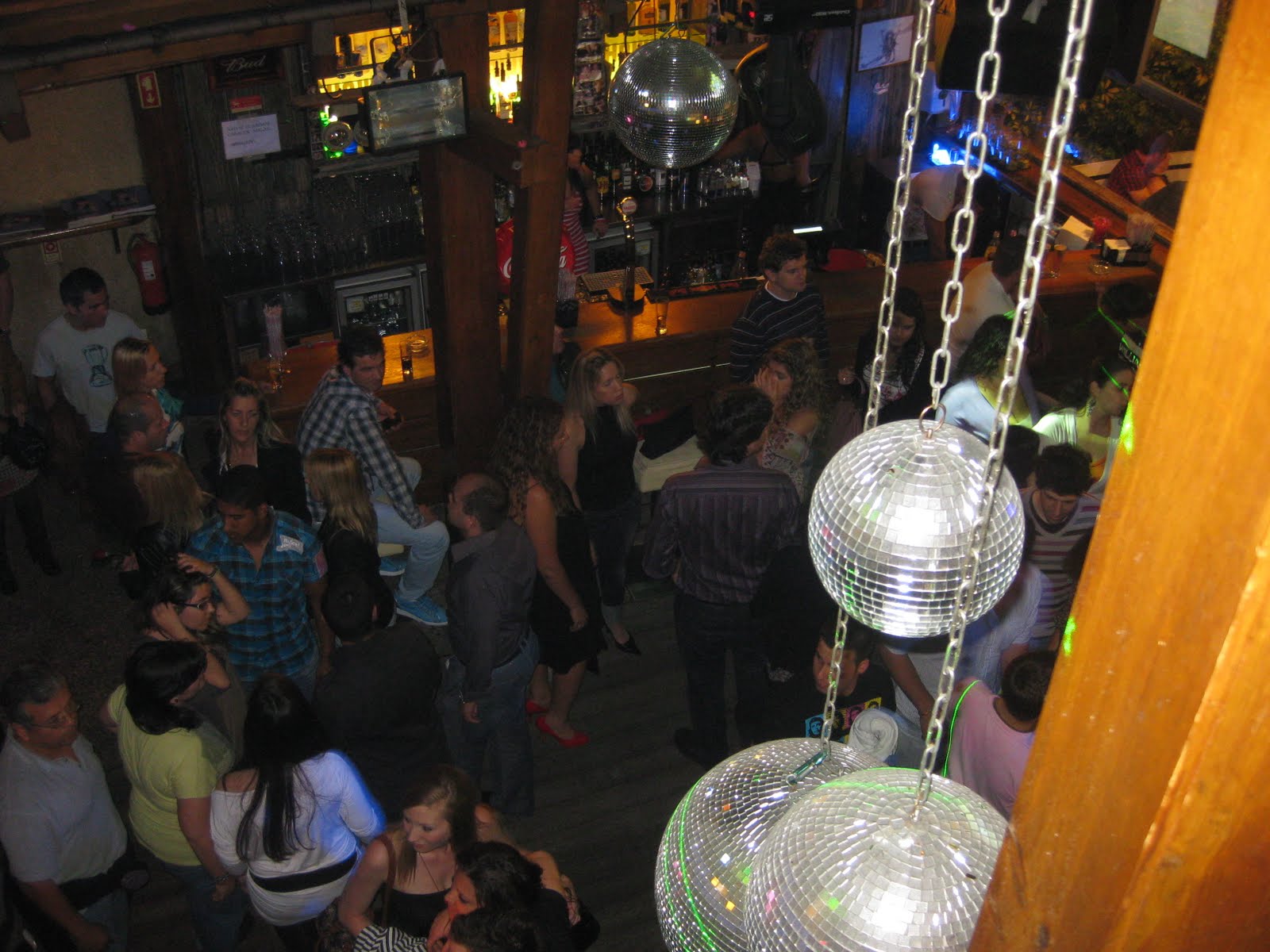
After dinner, we head to the Al Canterra neighborhood, with the waitress telling us to go to the “docas.”  The docks? We pull up to a roundabout and are greeted by a swimming pool on its side, lit up like a sculpture at night.  The “docas” remind us a bit of South Street Seaport, a line of bars along the water, with a mix of American pop music and Portugese dance music blaring out of every nightclub we pass.  We take a video of two couples dancing beautifully to Portugese music, and one of the women comes up to me and says, “This is not photo for YouTube.”  Laughing a little, I shake my head and wildly stress to her that no, no, I’m just taking photos from my vacation, not for YouTube.  She eases my concern by putting her hand on my shoulder, saying, “It is only to laugh.”  I know she meant to say she’s only kidding, but I really like this new expression.  Because so many times in life, “it is only to laugh.”

After making our way through a few of these nightclubs and enjoying the nighttime waterfront scenery and carefree culture, we are ready to head back to the hotel.  It’s around 1:30 a.m., and our taxi driver’s name is Marco.  He was a law student who had to stop his studies to go back to work, because of Portugal’s current financial crisis.  He’s determined to go back to finish his law degree in the fall, and wants to visit New York as soon as he gets his life in order.  We’re stopped at a red light when out of nowhere, Randi and I hear whistling and a voice yelling “taxi, taxi!” over and over again.  We look all around us to see where this voice is coming from.  Turns out, it is Marco’s cell phone ringtone.

Portugal – utter confusion followed by laughter and delight.

Arriving in Portugal, or, “Is this Really Happening?”

Portugal is certainly a confusing place.  From the mosaic tiled walls of the airport that remind me of the locker room of a public pool to the fact that classical music seems to be narrating our journey from the tarmac to the hotel elevators.

We deplane, and our luggage is the first to come off the conveyor belt (a first in my travel experiences to date.)  We take a cab to the hotel, and are only slightly ripped off by the cab driver.  We’re shocked to see how beautiful our hotel is – we booked it based on a flight/hotel package we found on Expedia (my first time doing so), and never imagined it’d actually be close to luxurious.  But it is – sprawling lobby with cherub statues, a spiral staircase leading up to the second floor and a friendly concierge staff eager to help us out.

It’s 6 a.m., and we know we can’t check in until after 2 p.m.  But we plan to drop off our bags at the front desk for them to hold until we check in.  We’re dreading this sleepy, delirious part of the trip, where we picture ourselves wandering the streets of Lisbon, tired and jetlagged, searching for pastries and coffee.   So when our concierge tells us he has a room available right away, we’re overjoyed.  They take our bags up to the room, and Randi and I collapse onto our beds, where we sleep for the next seven hours.  We’re both happy and completely horrified when we wake up at 1:30 p.m. and realize we’ve slept through our first morning in Portugal.

We shower and get dressed immediately and head down to the lobby, asking the helpful concierge where we can get a bite to eat near the Gulbenkian Museum, which we’ve deemed as our first stop due to the ominous rain clouds we see outside.  They recommend a bierhaus right near the museum, and when we arrive, we ask the uniformed guards standing outside the museum to help direct us to the restaurant, but they shake their heads and suggest a better restaurant.  In fact, they’ll lead us there themselves.  Now, I realize this might not be the best idea, two American girls gleefully following the young (and handsome) Portugese men, but remember – they had uniforms on, were on duty…

and it was broad daylight.  We follow them through the museum grounds, comprised of beautiful gardens, stepping stones, trees that make natural archways that seemingly lead to secret gardens but just keep opening up into sprawling greenery all around.  We step out of the gardens and are back in the city, and after passing a bride taking photos in front of the garden, we cross the street and arrive at the restaurant.  We are seated while the guards talk to the owners and help translate for us.   By translate, I mean they simply order for us.  I am told I’ll have the cod, the national fish of Portugal, and Randi will have the pork.  They also give us a bottle of white wine, which feels strange because we just woke up, but we go with it since we are, in fact, on vacation.

One of the guards, Ricardo, sits down with us and tells us all about his recent trip to New York, showing us photos on his cell phone.  Then he asks if we’re on Facebook.  The guards have to go do their rounds, but tell us to stay put.  This shouldn’t be a problem, since we haven’t gotten our food yet.  It’s interesting how we thought we were picking up a coffee and pastry for breakfast and yet, here we are, two glasses of wine deep and about to devour a meal of fish and meat.  They serve us delicious appetizers of bread and prosciutto.  I’ve been told to say no when they put extra food down on your table because they’ll make you pay for it, but I’m so hungry I just let them – and it seems rude to say no.

We never denied the food they offered in the beginning throughout the whole trip for fear of being rude – I suspect we probably paid a lot for that, but it was worth it.  I can barely speak the language; I can’t afford to be rude.  By the time my cod arrives, I’m too full of prosciutto to eat anything, but this ends up being a good thing because the cod isn’t very tasty.   The owner comes over, looking disappointed as he picks up our not entirely finished plates of food. He shakes his head to signify that we didn’t like the food.  We respond by rubbing our stomachs, trying to communicate that we were too full – but giving an “mmm” noise, to show that we really did enjoy the meal (lie.)  Still looking disappointed, the owner brings our plates to the kitchen.

The guards come back, carrying with them two tickets for the museum.  They speak with the owners, and then translate to us in a very stern voice, “They said you didn’t like the meal.” Again, we tell them how we were just too full to finish it.  After a series of eye rolls and back and forth between the guards and the owners in Portugese, we’ve clearly communicated our message, but no one seems any less disappointed in us.  We feel like we’ve represented America poorly here – aren’t we supposed to be obese and clean our plates?  Randi tells me that I simply need to lick my plate clean for the rest of the meals we have in this country (something I will fail to do, leading to more scolding and disappointment from restaurant owners all over Portugal.)  It really is a testament to how wasteful we are in America, the fact that we don’t even think twice about sending a plate back to the kitchen if it has some remnants of our meal left on it.


New Orleans and Me – A Love Story

Thank you.  Thank you place of employment, for giving me work on an account that allows us to do good things and sponsor cool events.  Thank you for putting me in charge of said events.  Thank you Laura Mayes for creating the Mom 2.0 summit and thank you Megan Jordan for not allowing horrible things to ruin your spirit, and for being the storyteller you are, on paper (shit…we need a new expression for this…on the interwebs?) and in person.  Thank you both for coming together to make the stories of hope event at the Eiffel Society in New Orleans a true success, on a professional and very personal level.

Thank you Heather Armstrong, queen of the mommy bloggers, for not running away when I approached you to tell you my old friend and former roommate was your biggest fan.  Thank you for remembering that she waited for three hours outside your book signing in Brooklyn so she could meet you face to face.  Thank you for remembering that her mom emailed you after she passed away last year to tell you what an inspiration you were to her, as an aspiring write herself.  Thank you for talking to me at length about her, and for being truly interested in the story of her life.  And thank you for what you did Saturday night, after being reminded of Robin’s story, in front of hundreds of people (and thousands of online followers) dedicating your story of hope to her.

Thank you universe for allowing me to play some role in having Robin’s idol honor her on a stage in a public setting, in front of so many other talented writers.  Thank you for allowing her memory to live on 15 months after her passing.  She must be going ballistic up in heaven knowing that the one and only Dooce so publicly acknowledged her.

What a vast difference this weekend was compared to that first trip to New Orleans.  From hating the cheesiness and spring break-like atmosphere to finally understanding it after interacting with those who were affected by the hurricane, to actually having a deeply profound evening that overwhelmed me with emotion.  New Orleans, we have quite the relationship.  If visit number one was an awkward first date, I think we just consummated our relationship, and I’m even inclined to say I may have just fallen in love with you.

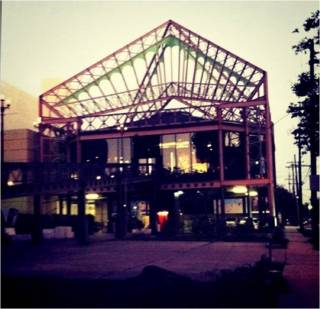
Saturday evening, we (we being Tide Loads of Hope) threw an event at the Eiffel Society, a beautiful structure that used to sit atop the Eiffel Tower.  The event, called “Stories of Hope,” featured 10 incredibly prolific writers who rose to fame because of their written musings on what we’re currently calling “mom blogs.”  This was the concluding event for the Mom 2.0 Summit, a “mom blogging” conference held this year in New Orleans.  We decided months ago that since New Orleans was the birthplace of the Tide Loads of Hope program and, let’s face it, Tide loves moms, we would absolutely have to be a part of this event.  We had each reader dedicate their story of hope to someone they knew who was affected by disaster.

Which is why I was so touched that, in addition to dedicating her story to someone she knew in Japan, Heather, queen of the moms, chose my old friend Robin, aspiring writer/designer/friend/fiancee, to honor.

Like I said, this trip to New Orleans was quite different.

All along, I thought traveling to different places was the most inspiring thing I could do.  Seeing beautiful places, going on new adventures.  Why did I fall in love with Morocco?  Was it the scenic coast of Essouira, or the overwhelming aromas of the souk? Did I love Guatemala because of the beautiful volcanoes I saw across Lake Atilan? Undoubtedly those scenes were breathtaking, but when I think back to some of the best trips I’ve taken, I think of the people.  I think of Hayat, and Tim and Brian, and the Moroccan families, and the Guatemalan children, and even the people with whom I traveled to these places.  Sure, I hated the cheesiness of Bourbon Street when I first stumbled upon it last summer.  When I saw Frenchman Street, the disappointment turned to appreciation and admiration.  But this time, this was a whole new level of amazement.  Could the Mom 2.0 summit have happened in any other city? Sure.  But if it had, would we have heard Megan’s story about losing her house in Hurricane Katrina, a story that went beyond anything she’s publicly written?  Did hearing her tale in person, in the very place where it happened give us all a stronger connection to the Gulf Coast? Absolutely.  Was I embarrassed to cry at a work function? No, I was proud.  Because it turns out, I’m not as inspired by the beauty of the places I go as I am by the people I meet while in said places.

At the end of the night, Laura and the Mom 2.0 gang made a donation to the Red Cross with the money from Tide’s sponsorship.  It’s hard not to walk away completely inspired when you’ve spent an entire weekend soaking up the awesomeness of creative women who are probably some of the best writers and storytellers in the country.   I went in as a PR chick only there to represent her brand and throw an event that people would enjoy.  I walked away feeling like part of a community.

And for that, women of Mom 2.0, writers, storytellers, families abroad, creators, designers – I thank all of you.


Ok, New Orleans, I finally get it.

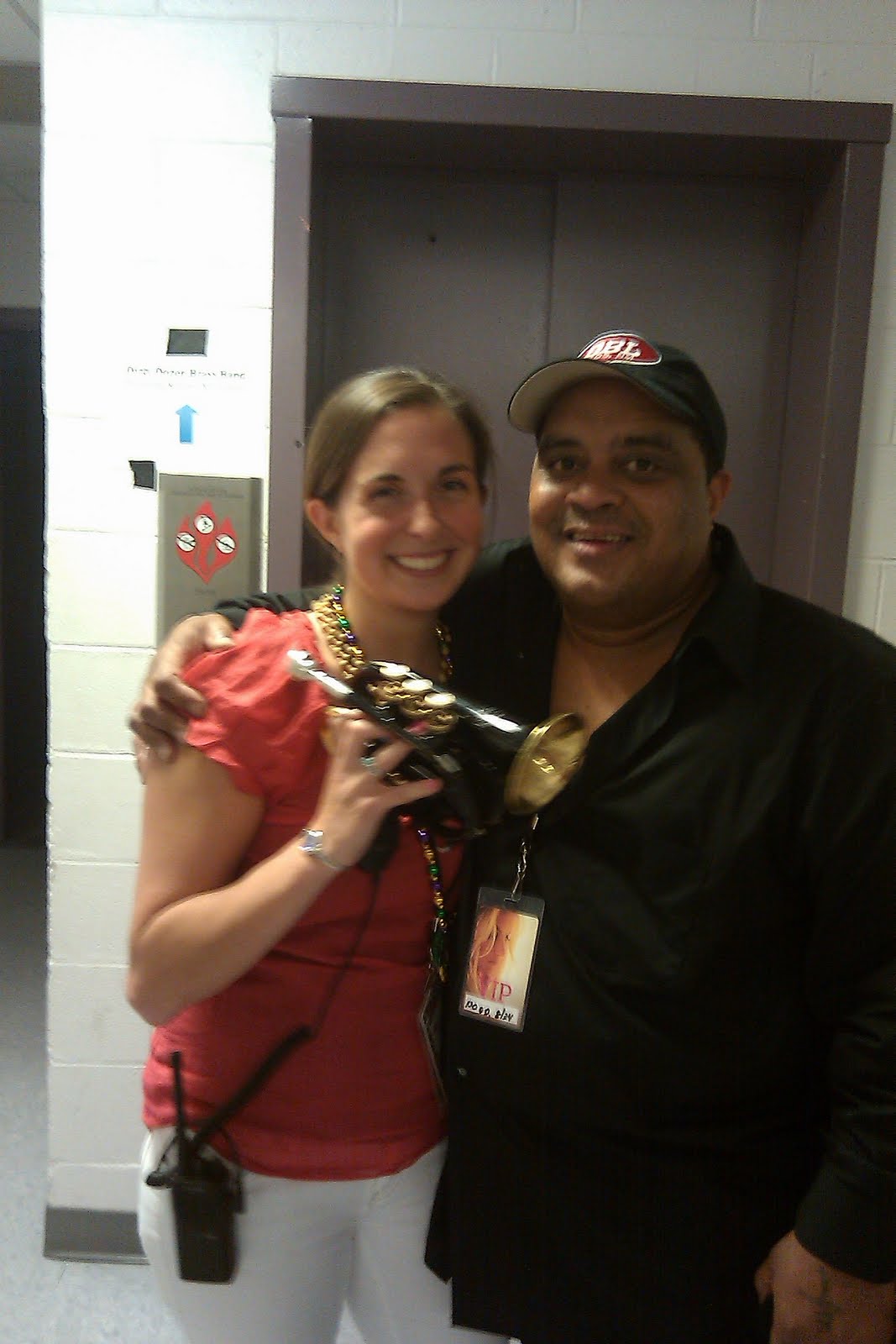
My summer of 12 hour workdays came to an end when my team and I traveled to New Orleans to put on a concert commemorating the anniversary of Hurricane Katrina. I’ll spare you the details, since I don’t want to make this a work related blog, but we basically paid a high level spokesperson (Faith Hill) to perform a concert in New Orleans to honor those who have stayed in the area in the five years since Katrina hit. I wrote about this in communication materials, spoke about it to media and spent months preparing for it, but I don’t think I actually GOT it until the evening of the actual concert. See, we made sure the theater was filled with local residents as well as people who worked at relief organizations in the area. About an hour before the concert, we realized a mistake had been made, and we had about 50 extra tickets right in the front orchestra section.

After I got over my panic attack and readjusted some of the seating, I took a handful of tickets, and right before the concert started, I made my way up to the upper balcony section. I went up to a couple and asked if they were with a relief organization. They actually said, “No, we’re with the fire department.” I looked at them quizzically and said, “Well, that’s certainly a relief organization,” and handed them two orchestra section tickets. They were amazed, and thanked me before going downstairs to take their upgraded seats. After handing out a few more tickets, word must’ve spread throughout the upper balcony to what I was doing. One elderly man came over to me and tapped me on the shoulder as I was giving out some more tickets to some folks from Homeland Security. He said to me, “I hate to ask, but is there any way you can upgrade me and my wife? We’re sitting all the way up there…and I know you’re giving these to relief organizations. I’m from St. Bernard’s Project, and I helped save thousands of lives when the hurricane hit.” I smiled, and handed him the two tickets I had that were closest to the front. He thanked me, and I said, “no…thank you!” I was thrilled to be the person to give something to this man who had clearly given so much to his community.

Later that evening, as the lights went down and Faith Hill took the stage, I was amazed that my team and I had just put on a large scale concert. But as amazing as that feeling of accomplishment was, the part of the evening that stood out most was being able to give something to that man I met in the upper balcony. In all communication leading up to the concert, we kept saying how this concert was about the people of New Orleans. And as great as it was to have coordinated such a high profile event, what we had been saying all along really held true, the evening wasn’t about the theater we had decorated, the production we had coordinated, or the celebrity we had signed on – it was wholeheartedly about the people of the area.

After the concert, my boss took us out to show us the “real New Orleans,” on Frenchmen Street. Again, I finally understood what people love about this town. We entered a small, dark bar, where there was a five piece brass band playing and four or five couples dancing in a way I had only seen in old movies. The quickness of their feet, the energy they exerted into the room, you couldn’t help but stop and stare…and wish you could dance like that. I felt like I had been transported to the 1940’s. And I loved it. After finishing an Abita beer, we headed to the next bar, where there was another brass band playing, and a female singer who had the most amazing voice, again feeling like we had been transported to the 1940’s. There was even a piano in the ladies room of this bar. It was hilarious, and incredible – like nothing I had ever seen before.

I finally understand why everyone falls in love with this town. Once I veered away from the chaos of Bourbon Street, met a few locals, and entered a few dark jazz clubs, it all began to make sense. And I won’t even get into the part of the evening when we followed the “bicycle balladerist” out of what our cab driver dubbed “the safe zone” and got some po’boys in the ghetto of New Orleans. Another experience I won’t soon forget. Our night ended with the Westin room service guy delivering complimentary ice cream to my room at 4 a.m., while I was devouring po’boys and other New Orleans delicacies on my bed with my bosses. Now, where else can you have an experience like that?

A Much Needed Local Mini Vacation


I haven’t enjoyed this summer at all. It started off as being filled with one obligatory event after another, disappointing experiences here and there, but then it kicked in to full on insanity when my normal workdays turned into twelve-hour-can’t-stop-for-one-second-to-breathe-or-eat-lunch kind of days. Then one morning I woke up to a phone call from my sister that her boyfriend had been hit by a car. He survived but was in critical condition. It was incredibly scary for the first few days until the situation became much less seemingly life threatening. Now he’s stuck at home in a neck brace for months, can’t move his left arm, and takes daily trips to various doctors. Last week I had heart palpitations and found out all the valves in my heart were leaky. Today my dad was in terrible pain and they think he has kidney stones.

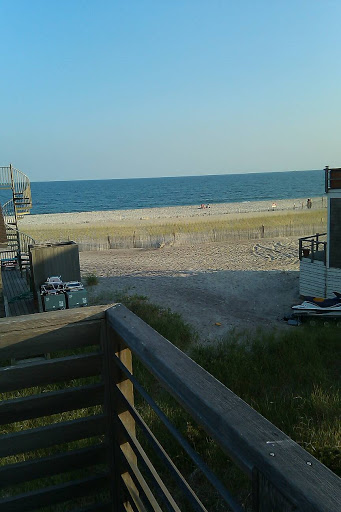
No one is enjoying their summer. We only get three months of good weather and it’s at this time that everything seems to be spiraling out of control. I know, it could be worse. Everything is on the mend and will be ok. I finally got to enjoy my summer this weekend for the first time. I went out to fire island with a group of friends and left everything behind. Ironically, it was the most beautiful weekend of the summer. We spent three days sitting on the beach until sunset, barbequing, sitting in the hot tub on our deck and boozing til the sun came up. I almost didn’t sign up for this summer share, but even for three days on Long Island, not so far from home, this weekend was the most necessary vacation I’ve ever needed. Here’s the view from our deck. I can’t wait to go back in August.

Published with Blogger-droid v1.4.9

From Cheesy to Cheesier

Although I can’t stand Atlantic City, for some reason I was excited to go New Orleans for the first time on a business trip this week. I was kind of disappointed to find that it was just one big cheesy spring break spot. I’m sure there’s local culture somewhere, but I definitely didn’t see it. Maybe it was because I stayed right in the French Quarter and didn’t know where to go to find the good jazz clubs and the famous New Orleans cuisine – although I did enjoy a delicious breakfast of chicory coffee and beignets at Cafe Du Monde. I also don’t recommend going in July, the humidity was like nothing I had ever experienced. I broke into a sweat upon exiting my hotel room, and walking around was brutal. I took three showers in one morning so I wouldn’t be a complete disaster when arriving at the venue I was checking out for our upcoming work event. I did stumble upon one really beautiful art gallery that featured local artists, mostly focused on jazz paintings and colorful fish murals. They were displayed in an outdoor garden which was really lovely to browse in.

Through the disappointing experience of seeing this new place I had always been curious about, I wondered if living in New York just made me completely immune to being surprised and impressed by anything anymore. Even the beautiful cathedral in Jackson Square, slightly removed from the cheesiness of Bourbon Street, was only okay to me – it looked like a less impressive version of the national cathedral in D.C. I didn’t even see the damn oil spill. At least that would’ve made me feel relevant and connected to something that’s going on in the world right now. Hopefully when I return next month for the actual work event, I get to explore more of this city and find out what the big deal is…

Morocco, Day 10 – Marrakesh to New York

The last night in Morocco, we sit down to dinner and talk about our trip highlights. Every single person reminisces about a memory they had with a loan recipient, either in Brian’s village of Midelt, Tim’s village of Tigmijou, or meeting Naima from Khenifra at the craft fair. I talked to Brian on the bus earlier that evening, about what he would do when he gets back to the US. He wants to go to business school, or maybe work for US Aid. I can’t imagine what it will be like for him to come back to the US and assimilate after spending so much time in this beautiful place, adapting to Moroccan culture for so many years. I’m worried about how I’m going to adjust after only ten days.

We say our goodbyes after breakfast and leave for the Marrakesh airport. The airport is filled with stranded European travelers. Joya’s boarding pass reads “Joshua,” but she gets through security anyway.

About ten hours later, I’m looking out the window of the plane as we pass over Long Island. I’m not sure I’m ready for this. We’re landing at JFK in ten minutes and I know I won’t be happy to go back to real life, to work, to the materialistic culture of NYC. But even here at home, I still have Nest. And I need to keep this experience close over the next few weeks…and for the rest of my life. Knowing what I do, when I’m running around the city trying to get restaurants to donate food to our event, when I’m stressing out trying to convince venues to host our event at no cost, I have to sit back and remember that every little effort we make helps the women we personally met here, who invited us into their homes and broke bread with us – knowing what we do every day helps them and people like them – that will make the post vacation transition more bearable, and will bring me back to how I felt in Morocco. This is why I do this, why all these amazing people around the world have come together for this cause. This trip made me realize that I’m living my dream, and helping others do the same.

Morocco, Day 9 – Tigmijou

April 19 – It is a rough morning. We’re all feeling the effects of the night before, and Joya almost kills me when I open the window to light the room (to find the advil and antacids). We go upstairs to breakfast on the roof and scarf down croissants, yogurt, crepes and assorted pastries. Joya and Kate want to order five more rounds of coffee, but I need air. I go to stand at the railing where I’m looking out at the ocean. I spend about a half hour out there, enjoying the beauty of the scenery in front of me. I can’t remember when I last felt this peaceful. I try to etch this morning into my memory so I can revisit it for years to come.

I finally pull myself away from this scene to go with Rebecca, Kate, Joya and the boys to the souk to buy olives, fruits and nuts to give the women of TIgmijou – they want to serve us food when we visit, but they don’t have the means to provide enough food to our group of 14. I buy a package of bracelets to give out to the girls and young children of this village. We spend the rest of our morning walking on the beach, looking at the camels and horses around us, taking in a view of the “castle in the sand” Jimi Hendrix supposedly wrote the song after, Joya riding a horse on the beach and some seashell collecting, we sit down to an outdoor lunch of mixed salads and tea.

The road to Tigmijou is incredibly scenic, with rolling hills and wildflowers of red, yellow and purple. The village is small, with four little clusters of houses. Tim lives in a house on a hill, a little removed from the rest of the village. We see three teenage girls giggling at us as we walk up the path to his house. We can’t go inside because it seems as though his roof has fallen over in the week he’s been gone. We walk through a meadow to get to the house of the family we’re going to visit. Along the walk, we pass a stray donkey grazing in the meadow. We enter a hut, built in the same Moroccan style of homes and guest houses we’ve been seeing – a structure with an open courtyard in the middle. Upon peering into the home, we see two young children – a boy and a girl, giggling and laughing and running up to us, then bashfully running away when we wave and smile at them. We enter into the courtyard and introduce ourselves to the women, kissing them twice on each cheek. We peer into one dark room where a woman is sitting at her loom, already strung. She is rapidly weaving the water reeds through the loom. Hicham, Tim’s young artisan who we met at the craft fair, says hello to all of us and Tim explains that all these people are part of Hicham’s family. We peer into their bedroom, with no door and rugs laid out for them to sleep on. The next room is the storage room, filled with these magnificent, completed water reed bags. We sell them back in the U.S. as market bags. My mother will purchase four of these bags from Nest’s website after hearing this story.

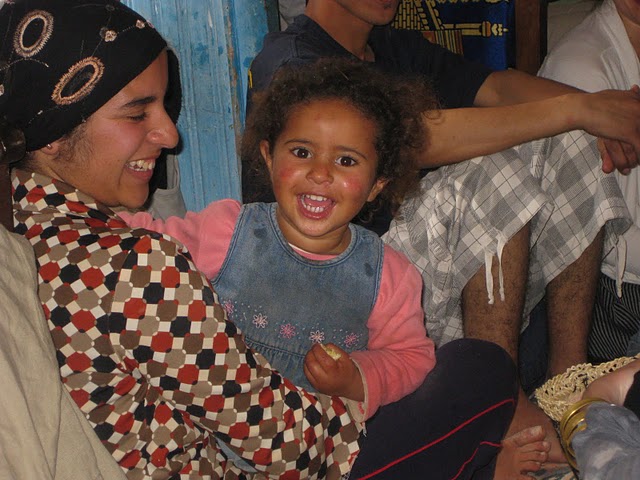
We enter another room off the courtyard, removing our shoes first. We sit around a bench with cushions and the women bring us the olives and fruits we purchased in Essouria. They also bring us bread and olive oil. I’m on the far side of the room – most of the women are sitting at the other end of the room near Tim and Brian, the only Arabic speaking people in the group. One of the family members comes over and sits near me. She starts breaking the bread and motioning for me to eat. I take a bite and say “beneen,” one of the two Arabic words I’ve learned – meaning delicious. The little toddler girl walks into the room and bursts into giggles. Everyone is laughing and smiling at her. The woman next to me is also laughing, and we exchange a glance, which sends us into a whole new fit of laughter. She tells me to eat more and I obey. I point to a water reed bag sitting next to her and ask if she made it (using hand motions). She nods and smiles. A child’s laughter, food, art, these are all universally appreciated. I couldn’t verbally communicate with this woman, but we were able to carry out an entire conversation while eating in her home.

Tim goes around and tells us about each of the women, how they are all related, and explains that they have a wedding to go to that evening because one of the girls from their town is marrying a man from the next village. When we’re done, we all walk out of the room, slip back into our shoes, and the women lead us to another house with a loom in it. I give out bracelets as we pass little girls and teenagers on our walk through another field of wildflowers. We take a quick look at the loom, but our driver is getting angry that we’ve taken too long, and threatens to leave without us if we don’t get on the bus immediately. He actually begins removing our bags from the bus at one point. Moroccans make their own rules. We say goodbye to the women, apologizing for our abrupt departure, and as we pile onto the bus a group of small boys laugh and bully each other as they watch us. Again, behaviors that transcend languages and continents.